

The Trump Administration is fast-tracking logging on more than 100 million acres of Forest Service land. But some locals are pushing back against one of the projects just north of Yellowstone National Park.
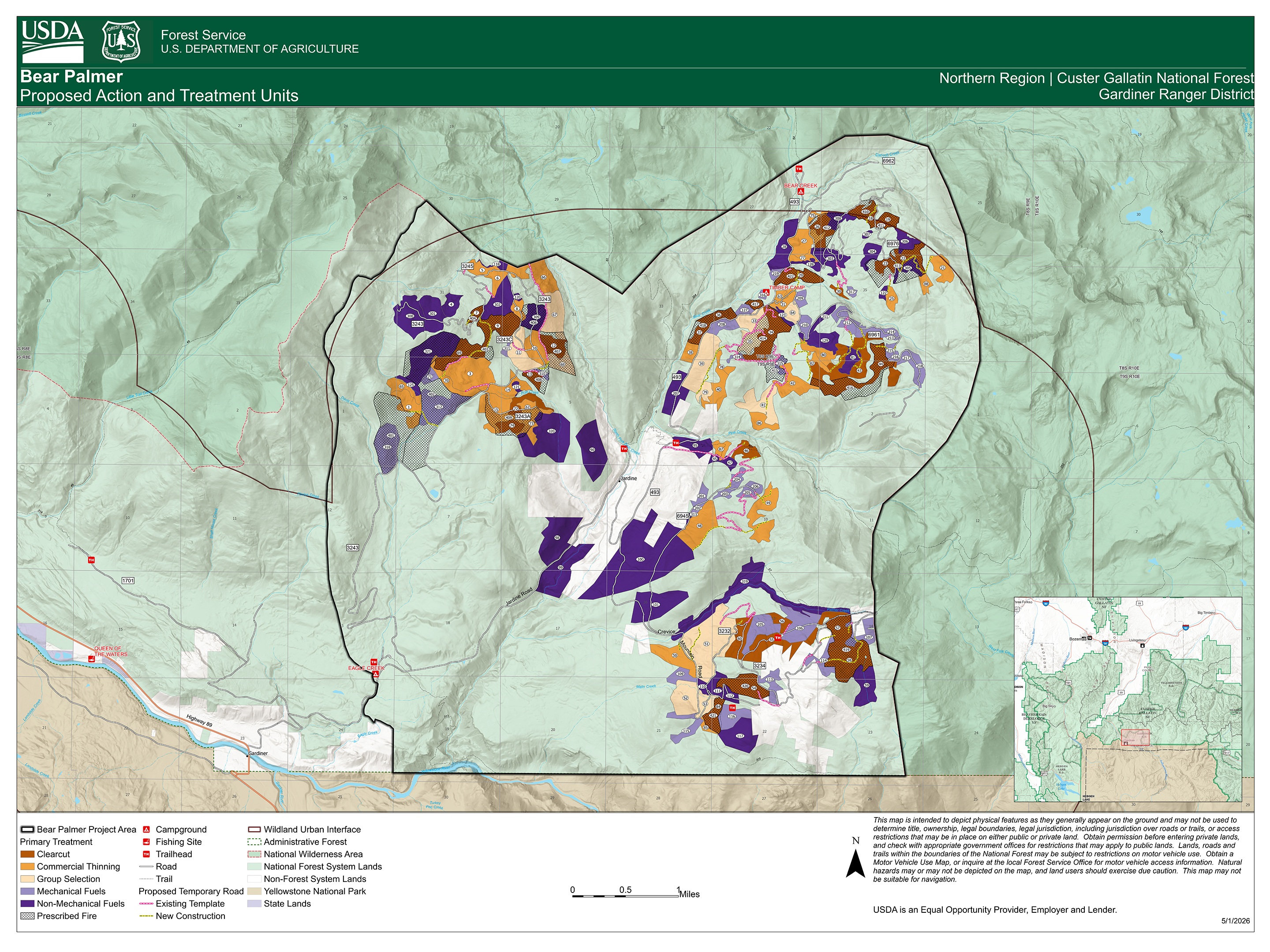
I meet members of the Bear Creek Council in a small cabin perched just outside the northern gateway to Yellowstone in the tiny historic mining town of Jardine. Bill Bridgeland, a retired wildlife biologist with a white beard, is hunched over a blown up print-out of a map of the proposed Bear Palmer project.
"Jardine’s right in the middle. And this dark line is the project area," Bridgeland points out.
It’s a Rorschach test for locals here. Blobs of purple and orange and brown show different types of logging, thinning, and prescribed burning that will, depending on who you ask, either revitalize the landscape or destroy it.
"The Forest Services is proposing to do about 4,400 acres of different kinds of what they call treatments which are a range of different intensities of activity," Bridgeland says. "It’s an area that is very critical to the Gardiner and Jardine community. It’s not appropriate for this area to have this kind of intensive logging."
The Forest Service didn’t respond to an interview request by our deadline. But agency documents cite a century of fire suppression as a culprit for overgrown forests ripe for insects and disease and wildfire. They say the treatments protect homes and communities, increase firefighter safety in the event of a wildfire and provide fire managers with more options should a fire break out. The documents also suggest that some of the treatments provide a more diverse, and therefore healthier, forest.
But some of the folks that live here see things differently.
"Excuse the language, I'd say BS on that," Ralph Johnson says. "BS, honestly, do you want my honest opinion on that?"
Clad in a cowboy hat, his dogs barking back in his truck, Johnson is an outfitter and lifelong resident of Jardine. He sees the project as part of the Trump Administration's broader attacks on public lands.
"It's all about money," he says. "It's about greed and it's about money, it's like the Boundary Waters, it's all like the Arctic National Refuge, the same thing."
President Trump issued an executive order to increase logging on federal land nationwide in March. In April, the head of the Forest Service directed the agency to increase timber harvest on national forests by 25 percent by 2028 and issued an “Emergency Situation Determination” for nearly 60 percent of the agency’s land. That designation opened up an area about the size of Sweden to fast-tracked logging projects without the traditional 45-day “objection period” for public commenters.
When Johnson heard the Bear Palmer project was getting pushed through under this new "emergency" designation, "I was totally shocked," he says.
"They're going to destroy this area. They're going to destroy the beauty, they're gonna destroy the wildlife habitat and they're going to destroy the tourism, because tourists are not going to pay to come up here and see a bunch of logging trucks and rippers and machines and caterpillars. It's going to really have an effect on my business."
Endangered species like grizzly bears, lynx and wolverines live here. Forest Service documents claim the project might hurt the species in the short term, but the impacts will be temporary. The area’s renowned for its elk herd, though Johnson worries about everything from squirrels to birds.
The single, washboarded dirt road in and out of Jardine will be crawling with logging trucks, he says. The noise will be deafening. Plus, council members say, the impact will be visible to the roughly one million tourists who pass through nearby Gardiner every year on the way to the park.
Wendy Thomas, another council member, takes me on a tour of part of the project area. .
We’re standing amid the yellows, purples, and whites of spring wildflowers – balsamroot, glacier lilies, larkspur, and phlox.
"You kind of get the drift that everywhere that we're going, you can look off into another drainage and see that that drainage is being nuked. And you go over here and you look back over here, and that's being nuked. I mean, it is akin to dropping a bomb in the entire Jardine Basin," Thomas says.
Looking back at these basins and thinking about the eventuality of them getting, as you put it, nuked, how does it make you feel?
"Oh, it's gut-wrenching, just having grown up and known the true value of what this is to humans and animals," Thomas says.
We can see the distant peaks of Yellowstone, the last bits of spring snow clinging to their summits as a storm rolls in. The project proposes 2,100 acres of commercial logging, 800 of them clearcuts. Trees have already been wrapped in tape.
In its documents, the Forest Service suggests that wildfire resilience is a main motivator for the project. Many fire ecologists suggest that thinning, followed by prescribed burning, can make forests more resilient to large-scale fire. The Bear Palmer project will include prescribed burning in about a quarter of the project area, including in this area right in front of us.
Some council members, though, have focused their comments on asking the agency to harden homes themselves to make them more resilient to wildfire rather than focusing on forests farther afield.
Thomas comes from a family of environmental advocates. Her father’s opposition to a logging project north of here decades ago helped establish the nearby Absaroka Beartooth Wilderness. She nervously watched the 1988 fires that scorched the whole region. But she thinks this project won’t make a lick of difference to the community’s resilience.
"'What if it burns? Log it or it's going to burn.' What if? My dad always said, don't live on what-ifs. And right now we've got something beautiful and sustainable up here. And I think that's the focus.

