


The Roadless Rule is back on the chopping block. And what happens next could have really big implications for Montana, the region, and the country – for grizzlies, for other endangered species, and for entire ecosystems.
What do we lose, or gain, when our bedrock environmental regulations go away, along with public input on how it all happens?
Welcome to the Wide Open. I’m Nick Mott.
We’re hard at work on our next season of the show. We’ll have more for you about what’s in store very soon.
But for today, I’m going to take you on a journey into a policy that’s a lot less well-known than the Endangered Species Act, but just as important for many of the animals that find themselves on the endangered list. To start, let’s go back in time. It’s the dawn of the new millenium. June, 2000. Portland, Oregon.
MEETING: My name is Harv Forsgren. I'm the regional forester for the Pacific Northwest region of the United States Forest Service.
At issue is something called The Roadless Rule.
FORESGREN: This is an issue that's been controversial for more than three decades. As an agency, we believe that it's time to address that issue in a comprehensive public forum.
The Forest Service, logging companies, and the public at large had been debating the values of these immense swathes of public land. Places that weren’t protected as, say, wilderness — but still had this outsized ecological importance.
It’s a meeting hall you might see today. Some microphones. Lots of empty stiff, red-backed chairs, but still a pretty solid turnout for a public meeting.
MEETING: This meeting today is one of over 300 that will be held across the nation in towns large and small to share information about our proposal and to take your comments to help us shape the final rule.
The Roadless Rule would protect more than 40 million acres of Forest Service land. That would mean, notably, no roads and no commercial logging.
The video’s a bit grainy, and it really is a slice of time. There’s a lot of the best of the 90s… think pastel colors, shoulder pads, some fun haircuts, the occasional pooka beads.
MEETING: the roadless areas that we're talking about protecting, are valuable far beyond the monetary value of the timber that's included within them. Valuable far beyond anything that we can even comprehend.
And from the outset, it’s clear there are these two camps: Those who want the areas protected, and those who want the status quo.
MEETING: this plan only serves the environmental elite.
This was Bill Clinton’s initiative and he was set to term out in just over six months.
MEETING: Clinton is not Teddy Roosevelt. Teddy Roosevelt set aside a forest service that allowed for multiple use. Bill Clinton, in turn, only has one management style, and that is to watch it burn.
This meeting was five hours long. I went through all of the testimony. And listening back to it made me think about this old image called a Rubin’s vase. You might’ve seen it. It’s a simple, black and white image. But some people see a vase, others, two faces staring at each other.
MEETING: We have only 4% of our native forests left, so roadless areas serve as islands of habitat amid a sea of clear cuts. Protecting these areas is integral to protecting biological diversity within our forests.
MEETING: Cecilia, would you like to say anything about the Yeah, you would? What would you like to say? Do it with me. Don't [3-year-old comes in] cut down on trees. Ready, one, two, three. Don't cut down the trees. Thank you very much.
MEETING: When Thoreau said, and wildness is the preservation of the world, I'm not sure whether he meant it literally, but it's literally true. It's an ecological fact.
This is often how these meetings go. One group of people sees a vase. The other, a face. Neither sees the whole of the image.
MEETING: Most of us live in wooden houses. Many more are being built today. And that lumber is coming either off of our land or is being imported.
MEETING: Please listen to the people who work and manage the forest, not the bureaucrats who are locked in the marble and cement jungles of Washington, D.C.,
MEETING: I keep hearing about Clinton's legacy, what about America's legacy? And I think America's Legacy is logging. We have been logging for over 200 years. Trees do grow back. And that's all I'd like to say, thank you.
Ultimately, Clinton enacted the Roadless Rule in January of 2001. And today, the drama around the Roadless Rule is back in a big way. Last summer, the Trump Administration proposed getting rid of it altogether.
"The federal government ties its own hands with burdensome regulations and does not properly manage the land."
Secretary Brooke Rollins, head of the Department of Agriculture, announced the idea last summer.
"Every year, nearly 100 million trees burn across our national forests, and about half of that land is off limits to common sense management. And that's all because of a regulation implemented almost a quarter century ago. With just one week left in his second term, President Clinton thought it was more important to lock up nearly 60 million acres of your national forest than to protect our communities, protect our drinking water, and protect our rural economies."
Today, on the Wide Open: The Roadless Rule is back on the chopping block. And what happens next could have really big implications for Montana, the region, and the country – for grizzlies, for other endangered species, and for entire ecosystems.
What do we lose, or gain, when our bedrock environmental regulations go away, along with public input on how it all happens?
To help me wrap my head around how the Roadless Rule came to be, what might be next for it, and what it could mean, I have Montana Public Radio reporter Ellis Juhlin with me. Ellis, so psyched to talk with you.
Ellis Juhlin: Hey Nick! Glad to be here.
Nick Mott: Ellis, you've been following the back and forth over the proposed repeal of the Roadless Rule since last summer. But a lot led up to the fight we’re seeing play out today. So, I want to start with the Roadless Rule itself.
Nick Mott: When did you become acquainted with the roadless rule?
Tim Preso: Well, I joined Earthjustice as a public interest environmental lawyer in March of 2000. And not long ago, I was dealing with some old files and saw the first notepad that I had when I joined the organization on the first page was the word roadless.
Nick Mott: Tim Preso is managing attorney at the nonprofit law firm Earthjustice. And he’s been thinking about — and litigating — the Roadless Rule just about his whole career.
Tim Preso: The Forest Service, basically at the behest of, you know, logging interests and their political allies, was really quite literally embarked on a program of liquidating our back country.
Ellis Juhlin: Timber harvests hit record highs in the late 1970s, and then again in the 1980s. There had been these heated battles over clearcutting and endangered species like the Northern Spotted Owl. People were worried that without guardrails in place, all our National Forests could be logged.
Nick Mott: For a time, clearcutting was the name of the game.
Tim Preso: It was going to result in this wholesale loss of landscapes that particularly we in the west hold dear in view as sort of part of our birthright is this you know wide open space of country that is you know still has a lot of natural integrity.
Nick Mott: By 2000, logging had gone down drastically on public land in the West. But the scars of the industry were still visible on the landscape, especially in the Pacific Northwest.
Ellis Juhlin: Enter, the Roadless Rule, or at least its earliest iteration! And there was a very coordinated campaign nationwide to get the rule passed.
COMMERCIAL: I used to think the forest was forever, so huge, so wild, that it would always be there for me when I grew up.
COMMERCIAL: But I guess even forests aren't forever, unless we decide to keep them that way. Forever. President Clinton, please protect the wild forest. There are inheritance.
Nick Mott: Some in the logging industry were nostalgic for those good old days of timber. So like you heard in that public meeting earlier, timber companies weren’t excited about the rule.
Ellis Juhlin: But lots of roadless areas were hard to get to. They didn’t make the most sense economically for loggers in the first place.
Nick Mott: Plus, there were already hundreds of thousands of miles of roads on Forest Service land. There was a never-ending backlog of maintenance on those roads the Forest Service just couldn’t get to.
Ellis Juhlin: The agency didn’t – and still doesn’t – have the money.
Nick Mott: Ultimately, public meetings like the one you just heard were one of the most defining elements of the Roadless Rule. The public was a part of the process just about every step of the way.
Ellis Juhlin: 1.6 million public comments came in for the rule. 99 percent were supportive.
Nick Mott: So - come 2001, the Roadless Rule got enacted.
Ellis Juhlin: As you might guess, there was a barrage of lawsuits. Lots of Western states in particular didn’t like the rule.
Nick Mott: And neither did George W. Bush, who took office just after the rule became law.
Ellis Juhlin: Caught up in the midst of the legal drama is Tim Preso.
Nick Mott: Earthjustice intervened in the suits, and suddenly he found himself at the heart of the high-stakes battle over protections for millions of acres of land.
Tim Preso: You could write a book about the twist and turns of the saga.
Ellis Juhlin: We’re not gonna walk you through every twist and turn.
Nick Mott: The court cases lasted a decade. But Preso and his colleagues kept winning. And in 2011, the legal kerfuffle over the Roadless Rule came to an end.
Ellis Juhlin: Facing states, even the federal government, Preso and his colleagues won it for good.
Nick Mott: The Roadless Rule as we know it today went into effect 10 years after it got enacted.
Tim Preso: At the end of the day, the winning the legal cases, you know, feels great. But the important thing was those roadless areas, and all that they hold, that is so important, increasingly important in our ever more crowded world, were secure. For that moment, at least. And so I think that was the most gratifying part of that.
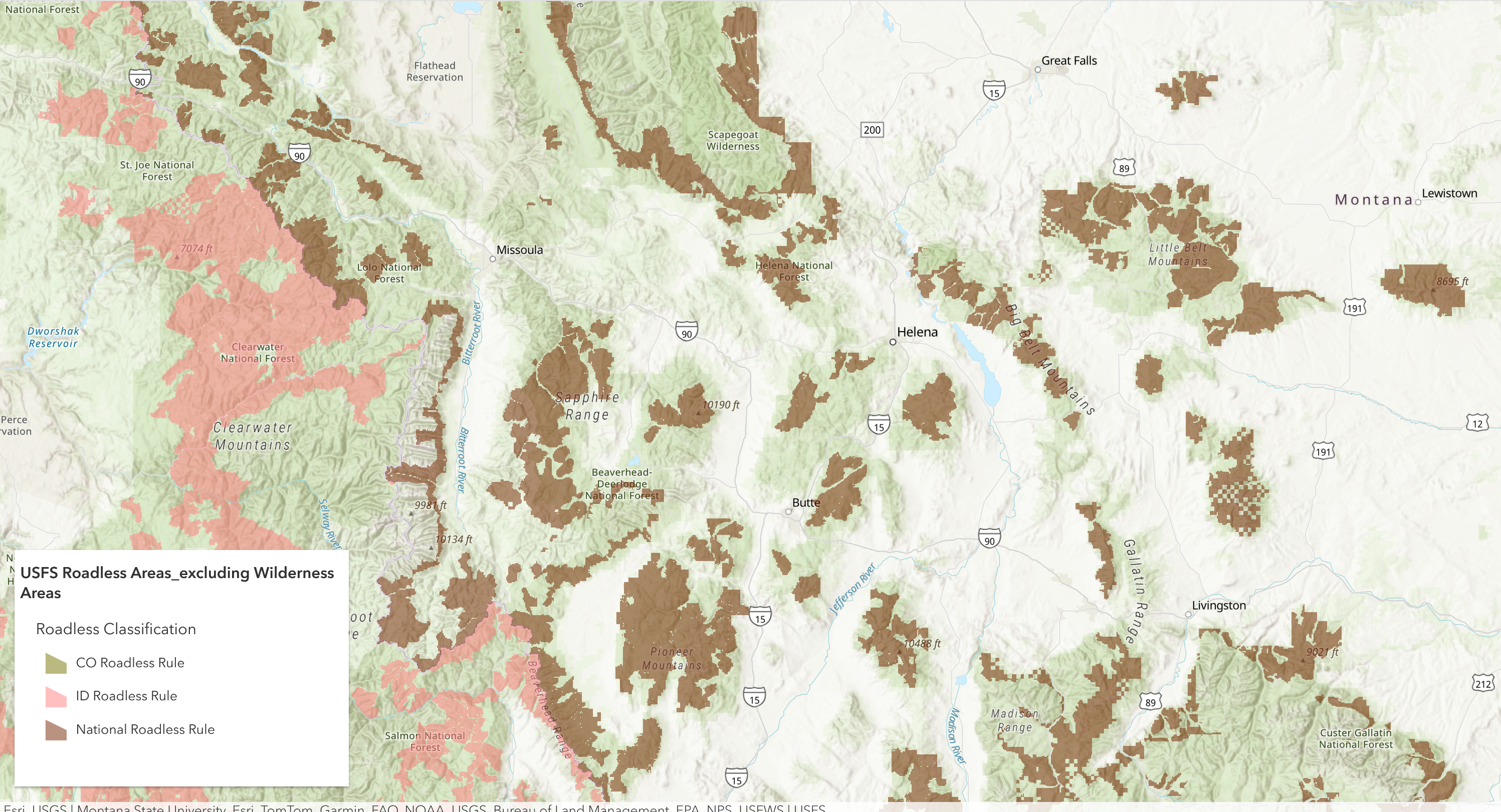
Nick Mott: Just shy of 45 million acres are designated as Inventoried Roadless Areas. There’s about 6.4 million acres just in Montana.
Ellis Juhlin: And these are places a lot of us are familiar with. I actually learned in my reporting on this that there are roadless areas in the mountains I see out my back door! (3)
Tim Preso: If you’re in, for instance, my home state of Montana, We’re talking about some landscapes that people really love. We're talking the Badger-Two Medicine on the southeast corner of Glacier National Park.
Nick Mott: They surround the Bob, and are on The North Fork of the Flathead —
Tim Preso: There are huge tracks of the Beaverhead Deer Lodge National Forest, the Big Hole, you know,
Ellis Juhlin: Chunks of the Crazies and the Castles and the Little Belts.
Nick Mott: The Sapphires and parts of the Bitterroot.
Tim Preso: We're taking about, you know, the west face of the Bridgers. So if you're sitting at a cafe in Bozeman and you're looking up at the Bridger's, you're look at an inventory roadless area that is protected by the roadless rule.
Nick Mott: When you enter a wilderness area, there’s often a sign: that classic Forest Service lettering. But in a roadless area, there’s generally no markers. They’re places we kind of take for granted. At least I have.
Tim Preso: We have all had the benefit of that now for a quarter of a century, many of us have been born and raised and come to adulthood in a world where those areas were protected and sort of assumed this is just the way things are, those areas are not going to be roaded and logged, and now that's all come back into question.
Ellis Juhlin: To help explain why roadless areas are so important, I’m going to bring in Brian Riggers. He spent about three decades with the Forest Service. He worked for a time as the roadless rule coordinator in Region 1, and as a fisheries biologist on the Lolo National Forest.
Brian Riggers: Generally the mountaintops are wilderness, the valley bottom is a private land And then you have this band of land in between in that band the sort of mid elevation ranges is where most of the roadless areas are.
Nick Mott: So we’re not necessarily talking the striking, jagged peaks here. But those mid-elevations are incredibly important places for everything from elk to wolverines and grizzlies find forage and safety throughout the year.
Ellis Juhlin: In fact, scientists have looked at the importance of roadless areas to species of conservation concern - meaning critters that are particularly vulnerable. One study found that 57 percent of those species have crucial habitat in Inventoried Roadless Areas.
Nick Mott: There are seventeen at risk species, just in Montana. Everything from bears to bumblebees, that rely on habitat in roadless areas.
Ellis Juhlin: To understand how critical roadless areas can be for wildlife, I think it’s helpful to dig in to just one particular species. Let's focus on bull trout.
As climate change continues heating up rivers across Montana - Riggers told me, bluntly, that the importance of these areas for fish can’t be overstated. (not sure)
Brian Riggers: If you were to take a map of bull trout spawning in western Montana and overlay it with inventory roadless areas and wilderness areas, it's almost 100% correlation. So, and that's not by chance, it's that those fish need cold, clear, clean water.
Nick Mott: And roads? They’re not so good for fish. Roads can mean more sediment flowing into streams, straighter channels, culverts that block access to upstream spawning areas, and all around worse habitat.
Ellis Juhlin: When it comes to bull trout, we aren’t talking hypothetically.
Brian Riggers: When I started working on the Lolo in 1992 or something. Um, there were dozens of streams that had bull trout.
Nick Mott: Riggers spent 20 years of his career as a fisheries program manager on the Lolo National Forest. That means he spent a lot of time looking for fish and documenting where they were.
Brian Riggers: We looked at all the populations across the forest and we looked, we compared those populations with the amount of disturbance or development upstream. So if there was a lot of road construction or a lot existing roads and a lot of timber harvest and a a lot of development versus not much, roadless areas essentially.
Ellis Juhlin: They found 32 watersheds that had good bull trout populations
Brian Riggers: And so we said in these areas where there's a lot of development, we're concerned that they're not going to persist for the long term. And that wasn't, you, know, a popular message at the time.
Nick Mott: But the message ultimately proved true.
Brian Riggers: if you look back at those now, almost all of those populations are gone. I could list off 10 streams right now that 15, 20 years ago had bull trout in them and they don't anymore. And to me that's a sad thing
Ellis Juhlin: We don’t know how many, or where, or how fast roads will be built if the rule gets rescinded. But we do know what those roads could mean for wildlife. And that picture is so much bigger than bull trout.
Nick Mott: Now that we’ve addressed the bull trout in the room, let’s talk about the elephant: wildfire. In addition to claims about timber harvests, the Trump Administration also says we need to get rid of the roadless rule to prevent wildfires and keep them from getting out of hand.
Ellis Juhlin: That’s right Nick, beyond the administration, this is a sentiment we’ve seen echoed by other folks that support repealing the rule. People like Nick Smith. He’s a forester who runs Healthy Forests Healthy Communities - a nonprofit focused on active forest management - things like thinning and prescribed burning. And he also works for the American Forest Resource Council. (2)
Nick Mott: Ah, a timber dude!
Ellis Juhlin: Exactly. He described the Roadless Rule as:
Nick Smith: A policy that is 25 years old from a different era of forest policy. And in our view, the rule is an outdated, rigid, top-down, one-size-fits-all policy that is not up to the challenges we face today in 2026.
Nick Mott: Let’s break down those unique challenges we’re facing today.
Ellis Juhlin: Totally. In an op-ed he wrote, Smith said we’re in an era of megafires.
Nick Mott: Right - enormous fires, burning severely at a huge scale.
Ellis Juhlin: Yep, and the smoky skies we’re all too familiar with in the West. Smith says there’s a slew of causes there. For one, a century of fighting fire has meant many forests are crowded with growth and ready to burn. Added to that, communities next to fire-prone areas have grown like, well, wildfire over the last few decades. And then there’s climate change
Nick Mott: Warming temperatures are having all kinds of impacts on fire severity and even the length of fire season. Plus, drought and insects and disease can all add stress on trees themselves.
Ellis Juhlin: So, Smith says, our forests are in full-on crisis-mode.
Nick Mott: He argues that a hands-off approach doesn’t work. We need to intervene and make our forests more resilient.
Ellis Juhlin: Instead of waiting for fires to pop up, we need to get ahead of them — and make the whole landscape safer.
Nick Smith: They need the ability to be proactive in implementing the right treatments in the right places, especially in forests that are at high risk of severe wildfire,
Nick Mott: So again, Smith is a timber dude. And the science does suggest that in specific ecosystems, very specific forms of logging can have a role in staving off the worst fires.
Ellis Juhlin: Thinning - meaning getting rid of the little trees in between the older, fire-adapted growth. Followed by prescribed burning.
Nick Mott: That’s careful fire put on the ground by experts in a very controlled way. Fire, after all, is a crucial part of our ecosystems.
Ellis Juhlin: But there’s lots of caveats here. Just logging or just thinning — that often doesn’t do much for wildfire risk at all.
Nick Mott: Plus, there’s the scale of the problem. At least 65 million acres of National Forest land are at a high risk of severe wildfire.
Ellis Juhlin: Taken together, that’s more land than the entire state of Oregon.
Nick Mott: We just don’t have the resources to get the work done at that scale. And there’s a huge backlog of that work already.
Ellis Juhlin: So instead, lots of folks think the best solution is to focus these treatments on areas near communities and other things that are important to us, like drinking water supply. Not farther out, in roadless areas.
Maggie Epstein: That would move the needle and make a big difference.
Ellis Juhlin: That’s Maggie Epstein.
Maggie Epstein: I am a PhD student in the Fire Center at the University of Montana, and I'm a firefighter as well.
Ellis Juhlin: Epstein works with a team of scientists that study decision-making around wildfires. Why people make the choices they do, and how that impacts the forest. 2
Nick Mott: Her background in the field gives her a unique insight in the other side of wildfire in roadless areas: fighting fire.
Maggie Epstein: I have rappelled into fires in roadless areas, no road required. A key difference between designated wilderness areas and inventoried roadless is that mechanized and mechanical access is allowed in roadless areas, so we can fly a helicopter and really easily, actually.
Ellis Juhlin: Like Epstein says, the roadless rule actually has exceptions that allow for treatments that reduce fire risk. And the perspective of firefighters is one she’d like to hear more included in this whole debate.
Maggie Epstein: The biggest misconception, the concern with the roadless rule and the justification for revoking it did not come from firefighters. This is not something that fire management asked for.
Nick Mott: I want to bring us back to Rubin’s Vase. Because wildfire itself is something that a lot of folks look at and see two totally different things. One is a threat.
Ellis Juhlin: Something to be destroyed and snuffed out.
Nick Mott: The other, though, is something natural, even crucial, to ecosystems.
Ellis Juhlin: This second view of fire, it’s Phil Higuera’s wheelhouse.
Phil Higuera: We can't just remove fire from our landscapes, because we're basically deferring risk, piling it into the future.
Nick Mott: Higuera is a fire ecology researcher and professor at the University of Montana.
Phil Higuera: The fires that humans start close to homes and structures that are the ones that are turning into crises it turns out big picture that's the minority of fires .
Ellis Juhlin: These are the problem fires. The ones close to communities. But the picture is different when you look out to places like wilderness - or roadless - areas. 3
Phil Higuera: That means we have lots of fires and in fact the majority of area burned that comes from lightning ignitions and really most the majority those fires, the vast majority of those fires burn without destroying homes, without loss of life and in a lot of cases those fires are doing work on the landscape. More or less consistent with the role that fire has played for thousands of years.
Nick Mott: In fact, Higuera says, there’s a really interesting relationship between roads and wildfires.
Ellis Juhlin: In a study published last March, researchers looked at how many fires started in national forests, and where. The data went back to 1992. And the results were striking.
Nick Mott: Roadless areas and wilderness areas had the lowest ignition rates.
Ellis Juhlin: The highest number of fires, though?
Nick Mott: Places with roads. In fact, fires within 50 meters of a road were about four times as likely as in a roadless area.
Ellis Juhlin: This is the gist of a letter Higuera wrote the USDA and Forest Service last fall with 30 scientists from across the country opposing the repeal of the roadless rule.
Nick Mott: And big picture, he says, roadless areas are some of the only places where fire can feasibly play its natural role on the landscape. Out there, it can breathe life back into ecosystems that desperately need it.
Phil Higuera: Any policy just starts with the rationale of less fire is better, sets us off in the wrong direction.
Ellis Juhlin: I also want to highlight one major difference between those meetings back in the late 90s you opened with and what’s going on today.
Nick Mott: Right, back then, there were over 600 public meetings hosted by the forest service across the country, and over one and a half million public comments gathered.
Ellis Juhlin: And that’s not how it’s looked this time around.
Nick Mott: After Secretary Rollins announced the intention to repeal the roadless rule last summer, the public comment period was three weeks long. There were almost 200,000 comments, and 99% of them were against the repeal. But —
Speaker 1 (Bozeman): Since the Forest Service announced their plan to rescind the rule last summer they have yet to hold a single public meeting on the topic.
Ellis Juhlin: Lots of folks all over the country weren’t gonna let that stand. Here in Montana, a group of wildlife, wilderness, and outdoor recreation organizations decided to hold their own public meetings. 3
Nick Mott: And groups in all kinds of other Western states have done the same. We went to meetings in Missoula and Bozeman. Hundreds of people showed up.
Ellis Juhlin: The echoes from those meetings a quarter century ago were palpable. Roadless areas, attendees said, hold so much more value than timber and minerals alone.
Ellis Juhlin: Speakers also recognized that this rescission wasn’t happening in a vacuum.
Nick Mott: Environmental rollbacks and cuts are happening across the board.
Ellis Juhlin: From slashed budgets and staff to rules to rolling back clean air and climate regulations to turbo-charging oil and gas drilling and other extraction.
Nick Mott: Our bedrock laws, from the National Environmental Policy Act to, of course, the Endangered Species Act, are taking hits too.
Ellis Juhlin: And this is something that some attendees at the meetings reflected on too.
SPEAKER: It’s like… WTF
Ellis Juhlin: This all builds and compounds. Attendees said through habitat loss and fragmentation, our public lands and wildlife — our grizzlies and our bull trout — will feel the brunt of the hurt here.
NAGLE: Wildlife has taken a severe hit more so than ever with this administration. And our purpose for protecting these roadless areas is for the protection of the biodiversity, ecological integrity. It's for wildlife connectivity.
Ellis Juhlin: In addition to the reasons why the roadless rule ought to stay in place, the process behind the rescission was also top of mind for lots of folks.
Speaker 3 (Missoula): The reality of public engagement in public land decisions is you make better decisions. And we can do that. But what's happened recently is the Forest Service has been closed off from the public.
Nick Mott: What unites all this is a core idea: If Rubin’s Vase shows us that we often see two different things when looking at an image — or, in this case, a policy — then the current administration is just focusing on one of those images. On our public lands and wildlife, they see dollar signs. They prioritize industry over the environment.
Ellis Juhlin: The government’s process in creating the Roadless Rule 25 years ago served a really crucial role in guiding how the policy came to be. Sure, it’s messy and it’s imperfect and not everybody gets what they want.
Nick Mott: But the idea behind holding all those public meetings, all those lengthy public comment periods, was that maybe we could find some middle ground. A shared understanding. The whole of the picture.
Ellis Juhlin: And here, at the end of the, well … road, it looks like that just isn’t happening.
CAL: They're actively not engaging with the public. They're trying to remove the public from public lands. I'm very proud of everybody in this room for showing up tonight. Hopefully you’re gonna use your voice and you’re showing that you care. I don't care what side of the issue you're on, I appreciate you being here. [applause]
Ellis Juhlin: Here’s what’s next for the Roadless Rule.2
Nick Mott: A Draft Environmental Impact Statement is expected any day now. There will be a brief public comment period that follows.
Ellis Juhlin: And the Forest Service says they expect a final decision on the rescission by the end of the year.
Nick Mott: Earthjustice attorney Tim Preso said if the administration does go forward with getting rid of the Roadless Rule, they’ll likely be in store for more litigation. But - as those grassroots public meetings attest, people are pushing back. Hard.
Tim Preso: One of the things that we learn over and over again is that these landscapes that we have the benefit of, today in terms of their natural values, places like Yellowstone and Glacier and the like, they're not there by accident. It happened only because people were willing to stand up and demand their protection and fight off efforts to develop them. And I think that time has now come again.
The Wide Open is a Production of Montana Public Radio. Music is by Izaak Opatz and Dylan Rodrigue. Special thanks to Ellis Juhlin for the reporting! We have more exciting reporting in the works for the show, so stay tuned.


